Tap Road vs Slope — Which Runner Is Harder?
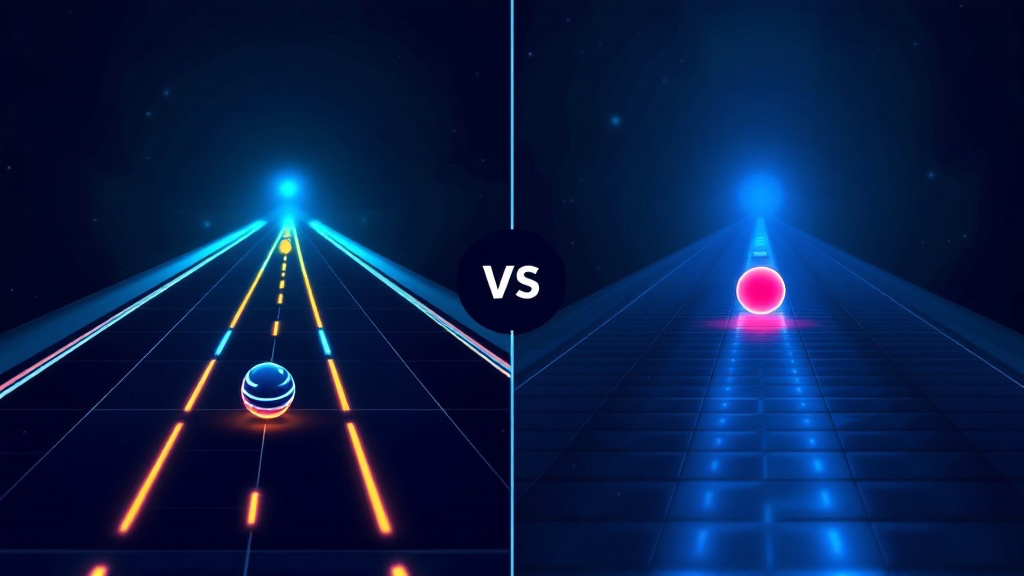
Tap Road and Slope are two of the most popular browser-based endless runners, and if you like one, you have almost certainly tried the other. Both drop you onto an endless track, ramp up the speed, and dare you to survive as long as possible. But beneath that shared premise, they are very different games — and the question of which one is "harder" does not have an obvious answer.
This Tap Road vs Slope comparison breaks down the two games across six dimensions: controls, difficulty curve, speed mechanics, visual style, learning curve, and replayability. The goal is not to crown a winner but to help you understand where each game punishes you, where it rewards you, and which one suits the kind of challenge you are looking for.
You can play Tap Road free online, try a slope-style session on the Tap Road Slope page, and browse more alternatives in Games Like Tap Road.
A Quick Overview of Each Game
Before comparing them, let's establish what each game actually is.
Tap Road
Tap Road is a lane-based endless runner. You control a ball that auto-advances along a track, and your job is to switch lanes to avoid obstacles and collect pickups. The input model is deliberately simple — tap left or tap right — which keeps the cognitive load low and lets the difficulty come from speed and obstacle density rather than complex controls. You can sharpen your reactions with the Trainer before going for high scores.
Slope
Slope is a 3D endless runner where you guide a ball down a procedurally generated slope. The ball is affected by gravity and momentum, and you steer left and right to avoid falling off the edges or hitting red obstacles. Unlike Tap Road's discrete lanes, Slope gives you continuous analog movement, which means precision matters at every moment, not just at decision points.
Controls: Simplicity vs Precision
| Aspect | Tap Road | Slope | | --- | --- | --- | | Input type | Discrete (tap left/right) | Continuous (hold left/right) | | Movement model | Lane switching | Analog steering | | Input precision needed | Low (timing-based) | High (positioning-based) | | Mobile friendliness | Excellent | Good but harder |
Tap Road's controls are its defining feature. Because movement is lane-based, you never have to worry about how far to move — only when. This makes the game accessible to anyone with a phone, and it means the skill ceiling is about reaction time and pattern recognition, not fine motor control.
Slope demands more from your hands. Because the ball moves continuously, you are constantly making micro-adjustments. Nudge too far left and you fly off the edge; not far enough and you clip an obstacle. The controls are still simple — just two directions — but the execution is unforgiving.
Verdict on controls: Tap Road is easier to pick up. Slope is harder to master.
Difficulty Curve: How Fast Do They Ramp Up?
Both games start gently and escalate, but the shape of that escalation is different.
Tap Road's difficulty curve is relatively smooth. Early runs introduce obstacles at a manageable pace, and the speed increases in noticeable but fair increments. A new player can survive for a respectable distance within their first few attempts, which creates a satisfying early-game loop. The wall hits later, when obstacle density and speed combine to demand near-perfect lane switching.
Slope's difficulty curve is steeper and less predictable. Because the track is procedurally generated, you can get a brutal sequence early in a run that feels unfair, or a forgiving stretch that lets you build a huge score. The speed ramps up aggressively, and once you are moving fast, the track geometry becomes harder to read in time to react.
| Difficulty Phase | Tap Road | Slope | | --- | --- | --- | | First 10 seconds | Gentle, learnable | Can already be lethal | | First minute | Fair ramp-up | Speed becomes serious | | 1–3 minutes | Obstacle density climbs | Track gets harder to read | | 3+ minutes | Demands near-perfect play | Demands reflexes + luck |
Verdict on difficulty curve: Slope ramps up faster and less predictably. Tap Road is more consistent, which makes it feel fairer but also means the difficulty is more "grindable" — you improve steadily rather than in sudden jumps.
Speed Mechanics: Linear vs Momentum-Based
Speed is where the two games diverge most fundamentally, and it is the biggest factor in which one feels harder to you personally.
In Tap Road, speed is largely a function of how far you have traveled. The game accelerates on a schedule, and your job is to keep up. There is no momentum to manage — the ball moves at the speed the game dictates, and you only control its lane. This means speed feels like a rising tide: predictable, steady, and something you can train against.
In Slope, speed is tied to gravity and the angle of the track. Steeper sections accelerate the ball, and there is no hard speed cap in the same way. The ball's momentum also affects how it responds to your inputs — at high speed, a small steering input carries you much further than at low speed. This creates a feedback loop where going faster makes the game harder, which makes you more likely to make mistakes, which (usually) ends the run.
| Speed Mechanic | Tap Road | Slope | | --- | --- | --- | | Speed control | Game-controlled | Physics-driven | | Speed cap | Effectively capped per run | Feels uncapped | | Momentum | None | Significant | | Predictability | High | Low |
Verdict on speed mechanics: Slope's momentum-based speed is harder to manage because it compounds. Tap Road's linear speed is challenging but legible — you always know roughly how fast you are going and how fast you will be going in ten seconds.
Visual Style: Clarity vs Atmosphere
Visual style is not just about aesthetics — in an endless runner, it directly affects difficulty. If you cannot see an obstacle in time, the game is harder, no matter how fair the mechanics are.
Tap Road uses a clean, high-contrast art style. Obstacles are clearly delineated, lanes are visually distinct, and the track reads well even at high speed. The neon palette is attractive without sacrificing clarity. This is a deliberate design choice: because the challenge is reaction time, the game ensures you always can see what is coming.
Slope goes for a more atmospheric look. The 3D track recedes into the distance, lighting shifts, and the procedural geometry can sometimes obscure what is ahead. At high speed, the visual noise increases, and reading the track becomes part of the challenge. This is atmospheric and immersive, but it adds a layer of difficulty that Tap Road deliberately removes.
Verdict on visual style: Tap Road is clearer, which keeps difficulty focused on reaction. Slope is more atmospheric, but the visual complexity is itself a difficulty multiplier.
Learning Curve: Time to Competence
How long does it take to feel "decent" at each game? This matters a lot for casual players who want a quick hit of challenge without a long investment.
Tap Road has a shallow learning curve. Most players understand the game within their first run and feel competent within ten minutes. The gap between "decent" and "great" is wide, but the gap between "beginner" and "decent" is small. This makes Tap Road an excellent pick-up-and-play title.
Slope has a steeper learning curve. The continuous movement takes getting used to, and the momentum physics are unintuitive at first. New players often fly off the edges repeatedly before developing a feel for how the ball responds. It takes longer to reach the point where a run feels satisfying rather than random.
| Learning Stage | Tap Road time | Slope time | | --- | --- | --- | | Understand the game | 1 run | 2–3 runs | | Feel competent | ~10 minutes | ~30–60 minutes | | Feel skilled | Several hours | Several days | | Approach personal ceiling | Weeks | Weeks to months |
Verdict on learning curve: Tap Road is faster to learn. Slope demands more upfront investment before it starts feeling fair.
Replayability: Why You Keep Coming Back
Both games are designed for replayability — that is the nature of the endless runner — but they hook you in different ways.
Tap Road's replayability comes from its progression systems. Skins, chests, and unlocks give you long-term goals beyond "survive longer." The Skins system in particular adds a collection layer that keeps you playing even when your reflexes are tapped out. You can also chase your personal best on the Score Tracker and compare against others on the Leaderboard, which adds a social dimension.
Slope's replayability is more pure. There are fewer meta-systems — you play because the core loop of "go fast, survive, beat your score" is inherently compelling. For some players this is a feature: no grinding, no unlocks, just skill. For others it means the game can feel thinner once the initial challenge wears off.
| Replayability Factor | Tap Road | Slope | | --- | --- | --- | | Meta-progression | Strong (skins, chests) | Minimal | | Score chasing | Yes | Yes | | Social competition | Yes (leaderboard) | Yes (informal) | | Variety per run | Moderate | High (procedural) |
Verdict on replayability: Tap Road offers more reasons to keep playing long-term. Slope offers a purer skill-based loop. Neither is objectively better — it depends on whether you want progression or purity.
So, Which One Is Harder?
Here is the honest, balanced answer: it depends on what kind of difficulty you find punishing.
Tap Road is harder if you struggle with rapid decision-making under time pressure. Because the game keeps accelerating and obstacle density climbs, the late game demands near-perfect lane switching at speeds that leave no room for hesitation. The difficulty is consistent and grindable, which means you will hit a wall, but you can chip away at it with practice.
Slope is harder if you struggle with continuous precision and momentum management. The physics-driven speed compounds, the procedural track can be unfair, and the visual complexity adds a layer of challenge that never fully goes away. The difficulty is spikier — you can die to a bad sequence early in a run that feels out of your control — but the highs are higher when you nail a fast, clean descent.
A Quick Summary Table
| Dimension | Tap Road | Slope | Harder? | | --- | --- | --- | --- | | Controls | Discrete, simple | Continuous, precise | Slope | | Difficulty curve | Smooth, fair | Steep, spiky | Slope | | Speed mechanics | Linear, predictable | Momentum-based, compounding | Slope | | Visual clarity | High | Moderate | Tap Road (harder to read = Slope harder) | | Learning curve | Shallow | Steep | Slope | | Replayability hooks | Many | Few | Even |
By a strict count, Slope is harder across more dimensions — but Tap Road's late-game speed ceiling is no joke, and players who have pushed both games to their limits will tell you that a max-speed Tap Road run demands every bit as much focus as a fast Slope descent.
Which Game Should You Play?
- Play Tap Road if you want an accessible, progression-rich endless runner you can pick up for five minutes and feel good about. It rewards consistency and gives you things to chase beyond a high score.
- Play Slope if you want a pure skill challenge with no hand-holding and are okay with a steeper learning curve and occasional unfair deaths. It is the better choice if you enjoy mastery for its own sake.
- Play both if you want to round out your reflexes. The skills overlap — reaction time, pattern reading, calm under pressure — but they stress different parts of your brain.
You can start with Tap Road, open Tap Road Slope for a downhill variant, and when you are ready to explore the broader genre, our Games Like Tap Road guide covers Slope Rider and the rest of the best endless runners worth your time.
Final Thoughts
Tap Road and Slope are often framed as rivals, but they are really two different answers to the same question: how do you make a ball going fast feel fun? Tap Road answers with clarity, progression, and fair escalation. Slope answers with physics, atmosphere, and raw skill. Neither is strictly better, and most players who love one will at least respect the other.
The hardest game is the one that punishes the skills you are weakest at. If that is precision and momentum, Slope will humble you. If that is sustained rapid decision-making, Tap Road will too. The only way to know for sure is to play both — and luckily, both are free to try. Play Tap Road or jump into Slope Rider now.