
Warm up in the Reaction Trainer, then play Tap Road while you apply these techniques.
Who This Guide Is For
This guide assumes you already understand the core controls, the gem system, and the basic speed phases of Tap Road. If you are still learning how the ball moves or when the game speeds up, start with the Tap Road Master Guide and the How to Play Tap Road page first. Everything below is written for experienced players who want to push past a plateau and survive consistently at maximum speed.
The gap between an intermediate runner and an advanced one is rarely about raw reaction speed. It is about reading ahead, training your eyes to cover more of the road, matching the game's rhythm instead of fighting it, and keeping your head cool when the pace becomes brutal. This guide breaks each of those skills down into drills you can practice today.
Predictive Tapping: Reading 3 to 5 Obstacles Ahead
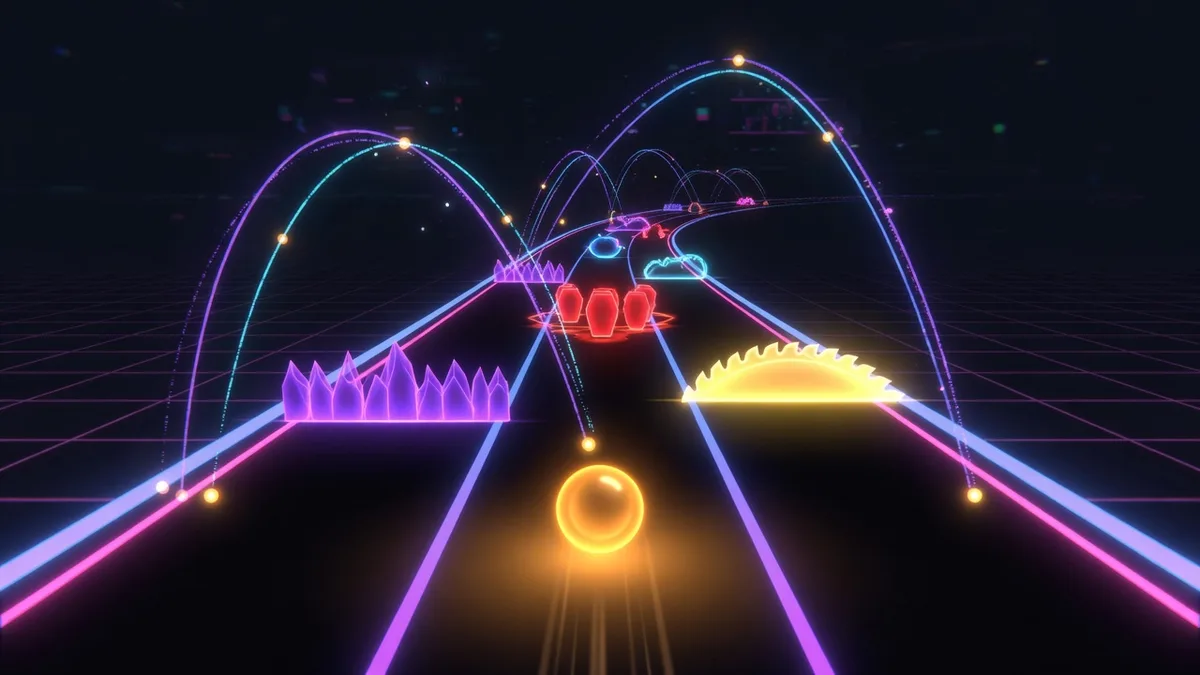
The single biggest difference between a good Tap Road player and a great one is how early they make decisions. Beginners react to the obstacle directly in front of the ball. Intermediate players look one or two obstacles ahead. Advanced players plan three to five obstacles ahead, so by the time an obstacle reaches the ball the input has already been queued and committed.
This matters most at maximum speed, where the window for a correct tap shrinks to a fraction of a second. If you wait until an obstacle is on top of the ball to decide, you are already too late. Predictive tapping turns the game from a reaction test into a planning exercise, which is far more reliable under pressure.
How to Build the Read-Ahead Habit
Start by deliberately shifting your focus up the road. Pick a point roughly three obstacles ahead of the ball and make your tap decisions based on what you see there, not on what is closest. At first this feels uncomfortable and you will crash more, because your brain is used to reacting. Stick with it for a full session before judging the results.
A useful drill is the silent count: as each obstacle enters your read-ahead zone, count it silently — one, two, three — and decide the tap for obstacle one while you are already looking at obstacle three. This forces your attention forward and stops you from fixating on the current input.
Reading Obstacle Chains, Not Single Obstacles
Advanced players do not see five separate obstacles; they see one chain with a shape. A sequence that asks for left-right-left is processed as a single zig-zag pattern, not three independent decisions. Chunking like this reduces mental load and lets you execute long sequences on autopilot once you recognize them. We cover the most common chunked patterns later in this guide.
The practical rule: never let your eyes rest on the ball. The ball should live in your peripheral vision while your focus stays on the road ahead. If you notice yourself watching the ball, that is a sign your read-ahead has collapsed and a crash is imminent.
Peripheral Vision Training
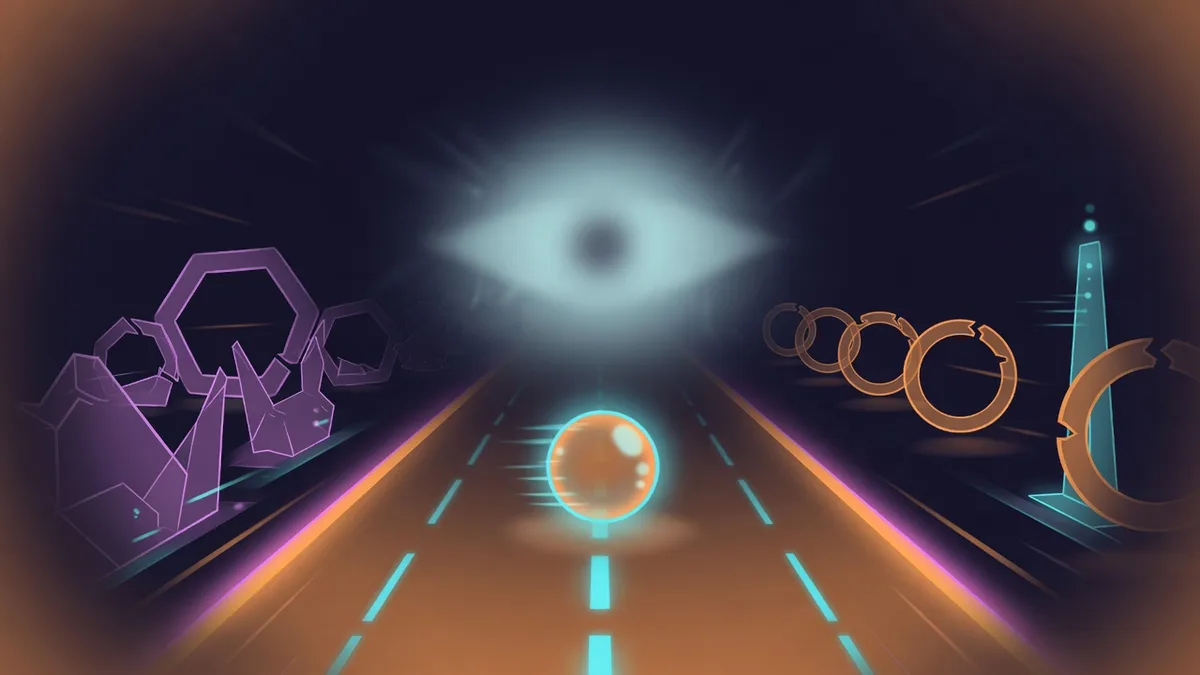
Reading ahead only works if your eyes can actually take in a wide slice of the road at once. Most players narrow their focus to a tiny spot when the game gets fast, which is the opposite of what they need. Peripheral vision training widens that useful field so you can track the ball and the upcoming obstacles simultaneously.
The Soft-Gaze Technique
Instead of staring sharply at one point, soften your gaze. Pick an anchor point about a third of the way up the visible road and let your vision relax so the ball below and the obstacles above both register without you moving your eyes. This feels unnatural at first because everyday screen use trains hard focus, but within a few sessions it becomes second nature.
A good self-check: if you can describe the color or shape of an obstacle two positions ahead without having moved your eyes to look at it, your soft gaze is working. If you cannot, you are still hard-focusing and need to relax your stare.
Progressive Vision Drills
Build the skill in stages rather than jumping straight into a full speed run. Try this progression over several sessions:
- Stage 1 — Wide anchor: Play at a comfortable speed and hold a soft gaze on a fixed anchor point. Do not worry about score; just keep the gaze stable for a full run.
- Stage 2 — Two-ahead tracking: While holding the anchor, consciously track two obstacles ahead in your peripheral vision. Note their lane before they reach the ball.
- Stage 3 — Distraction layer: Add a mild distraction such as background music with an irregular beat. The goal is to keep your gaze stable despite audio pulling your attention.
- Stage 4 — Full speed transfer: Move into the fastest phase you can reach and apply the same soft gaze. If your vision collapses back to hard focus, drop a speed tier and rebuild.
Vision gains compound. Once your field widens, read-ahead becomes easier, which lowers panic, which keeps your vision wide. The reverse is also true, which is why players spiral into crashes once they start hard-focusing under pressure.
Rhythm Matching
Tap Road's obstacles often arrive at a steady interval, which means the game has an underlying beat. Rhythm matching is the practice of syncing your tap cadence to that beat so your inputs stay even and predictable. When you fight the beat — tapping early, then late, then early again — you introduce micro-errors that become fatal at high speed.
Finding the Internal Metronome
On your next run, instead of trying to react, listen for the pattern. Many obstacle sequences have a regular spacing that you can feel as a pulse. Once you lock onto that pulse, let your taps ride it. You are not speeding up or slowing down to each obstacle; you are keeping a steady cadence and letting the obstacles meet your taps.
This is the same principle musicians use when playing with a click track. The clicks do not speed up for you; you align to them. In Tap Road, aligning to the game's pulse removes the jitter that comes from reactive tapping and gives you a stable base to layer read-ahead decisions on top of.
When Rhythm Breaks
Not every section has a clean beat. Some sequences deliberately break the pattern with a late or early obstacle to punish players who have gone on autopilot. The advanced skill is recognizing when you are in a steady-rhythm section versus a broken-rhythm section, and switching modes. In steady sections, trust the metronome. In broken sections, drop back to pure read-ahead and treat each obstacle individually until the pattern resumes.
Micro-Tap Timing
At maximum speed, the difference between a clean pass and a crash can be a few milliseconds. Micro-tap timing is the precision layer on top of rhythm matching: not just tapping on the beat, but tapping at the exact moment within the beat that the game expects.
Two things destroy micro-tap timing. The first is tension — a tight hand or thumb moves slower and less precisely than a relaxed one. The second is over-correction — if you tap slightly early and then panic-adjust on the next input, you chain errors instead of resetting. The fix for both is to keep the input mechanism relaxed and to treat each tap as independent, even when they come in quick succession.
For mobile players, micro-tap timing is especially sensitive to setup. A smudged screen, a thumb that drags, or a browser bar that shifts the play area can all throw off a few-millisecond window. If your timing feels off across an entire session, check your physical setup before blaming your skill. See the Tap Road on Mobile guide for detailed setup advice.
Pattern Recognition: Common Obstacle Sequences
Tap Road reuses a finite set of obstacle sequences, and recognizing them instantly is what lets advanced players chunk long stretches into a single executed motion. Once you can name a pattern, you can pre-load the entire input string instead of deciding each tap individually.
Below are the recurring sequence families you will meet at higher speeds. Learn to spot the opening cue of each one so you can commit to the full chain without hesitation.
The Zig-Zag Family
Alternating lanes — left, right, left, right — sometimes for four or five obstacles. The trap is over-tapping: players see the alternation and speed up, finishing the chain early and crashing into the obstacle after it. The fix is to let each tap land fully before starting the next, keeping the rhythm even rather than accelerating.
The Double-Step Family
Two obstacles in the same lane with a short gap, followed by a switch. The cue is a quick repeat in one lane. The danger is treating the second obstacle as a new decision and tapping late. Once you recognize the double-step, execute both inputs as a single “double” motion.
The Compression Family
Obstacles that gradually close their spacing, forcing faster and faster taps. This is where rhythm matching breaks down if you are not ready. Read the compression early, accept that the cadence will rise, and accelerate your metronome smoothly rather than getting surprised by each tighter gap.
Common Mistake Patterns by Sequence
Tracking which sequences kill you most often turns vague frustration into a concrete training target. Use the table below as a starting checklist and customize it with your own crash data.
| Sequence Family | Typical Mistake | Root Cause | Fix Drill |
|---|---|---|---|
| Zig-Zag | Over-tap, finish chain early | Accelerating the rhythm | Hold even cadence, count each tap |
| Double-Step | Late tap on second obstacle | Treating it as a new decision | Pre-load both inputs as one motion |
| Compression | Surprised by tighter gaps | Fixed metronome, no acceleration | Read compression early, ramp cadence |
| Broken-Rhythm | Autopilot tap on the off-beat | Trusting a beat that no longer holds | Switch to per-obstacle read-ahead |
| Long Straight | Loss of focus, late first turn | Attention drift with no inputs | Use straights to reset gaze forward |
Speed Phase Strategies
Tap Road does not run at one constant difficulty. It moves through speed phases, and the optimal strategy shifts with each one. Treating the whole run the same way is a common plateau cause.
Early Phase: Build the Buffer
In the opening phase the pace is forgiving. Use it to establish your soft gaze, lock onto the game's rhythm, and collect safe gems to build a buffer. Do not show off. The early phase is not where runs are won, but it is where bad habits — hard focus, reactive tapping, greedy gem grabs — get embedded. Play it clean and deliberately.
Mid Phase: Tighten the Read-Ahead
As the speed climbs, extend your read-ahead from two to three or four obstacles and start chunking sequences. This is also where you should become more selective with gems: only take ones that sit on your existing safe line. Any gem that asks you to deviate or delay an input is now a risk that grows with the speed.
Top Phase: Pure Survival
At maximum speed, survival is the only goal. Stop chasing gems entirely unless one falls directly in your path. Narrow your attention to read-ahead and rhythm and let peripheral vision handle the ball. If you feel your gaze collapsing to a hard focus, that is the warning sign of an incoming crash — consciously relax and widen your view, even if it costs you a beat.
Technique Comparison Across Phases
The right tool depends on the phase you are in. Forcing an early-phase habit into the top phase, or vice versa, is a fast way to crash.
| Technique | Early Phase | Mid Phase | Top Phase |
|---|---|---|---|
| Read-ahead depth | 2 obstacles | 3 to 4 obstacles | 4 to 5 obstacles |
| Gem policy | Collect safe ones | On-line only | Ignore unless free |
| Rhythm mode | Steady metronome | Steady with chunking | Adaptive, broken-rhythm ready |
| Gaze focus | Establish soft gaze | Hold soft gaze | Defend soft gaze actively |
| Risk tolerance | Low, build habits | Calculated only | Zero, survive |
Risk vs. Safe Play: When to Gamble
A persistent question at the advanced level is when to take a risk and when to play safe. The framework that works best is expected-value thinking borrowed from competitive games: weigh the upside of a risky action against the cost of losing the entire run.
At low and mid speed, a single gem is worth a small detour because the crash risk is low and the run is short enough that restarting is cheap. At top speed, the run itself is the valuable asset. A failed risky collect costs you everything you have built, while a skipped gem costs exactly one collectible. The math flips hard toward safe play as the speed rises.
Take a calculated risk only when three conditions are met at once: the gem sits clearly on your existing safe line so it requires no real deviation, you have a clean buffer of open road around it, and your rhythm is currently stable. If any one of those is missing, skip it. For a deeper framework on weighing gem value, read the Tap Road High Score Tips guide.
One more rule: never take a risk immediately after a near-miss. A close call spikes your heart rate and narrows your vision for the next few seconds, which is exactly when a gamble is most likely to fail. Survive the near-miss, reset your gaze, and only consider risks once your rhythm has stabilized again.
The Mental Game

Physical skill gets you to the advanced tier; mental game keeps you there. Tap Road is a game of sustained concentration where a single lapse ends the run, so managing pressure, focus, and frustration is as important as any tapping technique.
Dealing With Pressure
As you approach a personal best, the stakes feel higher and your body responds as if the run matters more — tighter hands, shallower breathing, narrower vision. All three directly hurt the skills you need. The counter is to deliberately de-value the current run in your mind. Tell yourself this is just a practice rep, not the record attempt. The goal is to make your execution at score 500 identical to your execution at score 50. Players who can do that are the ones who actually break their bests, because they do not choke when it counts.
Tilt Management
Tilt is the cascade where one bad crash makes you play worse, which causes more crashes, which makes you play even worse. It is the single biggest score-killer for experienced players because your mechanical skill is not the problem — your state is. Use a fixed reset ritual after every crash: name the cause out loud (late tap, greedy gem, lost focus), take three slow breaths, and start one low-stakes warm-up run before chasing a new best.
Set a hard session cap. When you feel tilt building — usually marked by faster, angrier restarts and a urge to “get it back” — stop. Tilt does not resolve by playing more; it resolves by stepping away. A five-minute break resets your state far more effectively than ten forced runs.
Focus Techniques
Long Tap Road runs are an endurance task for your attention. Two techniques help sustain focus. The first is a pre-run focus cue: a single word or phrase you say before starting that reminds you of your goal for the run, such as “soft gaze” or “read ahead.” This primes your attention before the first obstacle appears. The second is mid-run resets: during any long straight with no inputs, use the brief idle to re-check your gaze and breathing instead of letting your mind drift. Straights are free focus-refresh windows if you use them.
Analysis Techniques: Reviewing Your Runs
You cannot fix what you do not measure. Advanced improvement comes from treating every session as data. After each run, log three things: the score, the speed phase you reached, and the crash cause. The crash cause is the most important field — be specific. “Late tap” is okay; “late tap on a double-step in the top phase” is far more useful.
Every few sessions, re-read the log and look for the most common crash cause. That single weakness is your next training target. Dedicate the following session to that one problem instead of playing generically. This is how you turn vague “I keep dying” frustration into a concrete, fixable issue. Use the score tracker to keep these logs organized, and check the leaderboardoccasionally for motivation — but remember your most reliable benchmark is your own logged progress, not someone else's claimed score.
For isolated reps on a problem sequence, the trainer lets you repeat the same scenario without restarting a full run. Drilling your weakest pattern for a few minutes before a real run is one of the highest-leverage habits you can build.
A Sample Training Schedule
Improvement comes from structured practice, not endless grinding. A balanced week touches vision, rhythm, pattern drills, mental game, and real runs. Treat the schedule below as a template and adjust the split based on your logged weaknesses.
| Day | Focus | Activity | Time |
|---|---|---|---|
| Day 1 | Vision | Soft-gaze drills, two-ahead tracking | 15 min |
| Day 2 | Rhythm & micro-tap | Steady-cadence runs, relaxation checks | 15 min |
| Day 3 | Pattern drills | Trainer reps on weakest sequence family | 15 min |
| Day 4 | Read-ahead | Silent-count runs, 3 to 5 obstacle planning | 15 min |
| Day 5 | Mental game | Reset ritual practice, capped low-stakes runs | 15 min |
| Day 6 | Real runs | Full attempts with logging and review | 20 min |
| Day 7 | Review & rest | Re-read crash log, set next week's target | 10 min |
The key is that each day has one clear focus, not a mix of everything. Trying to improve vision, rhythm, patterns, and mental game in the same session splits your attention and slows progress. Isolate one skill per session, then let the real-run day integrate them.
Putting It All Together
Advanced Tap Road play is a stack: peripheral vision feeds read-ahead, read-ahead feeds rhythm matching, rhythm matching feeds micro-tap precision, and mental game keeps the whole stack from collapsing under pressure. Weakness at any layer leaks into the others, which is why a structured training schedule and honest run review matter more than raw hours played.
Start with the layer your crash log says is weakest, train it in isolation for a few sessions, then reintegrate it into full runs. Over a few weeks the stack stabilizes and your consistent top-speed survival will improve far more than it would from simply playing more games. If you are also working through skin unlocks alongside skill gains, the Tap Road Skin Collector's Roadmap pairs well with this training plan.
Remember: this site is a fan-made strategy resource, not the official game developer. Game mechanics and speeds can change with updates, so always test these techniques against the live version you are playing and adjust as needed. Your own logged data is the final authority on what works for you.
Try These Tools
View all tools →Reaction Trainer
Reflex mini-game with difficulty tiers and session history
Score Tracker
Log runs, see progress curves, export your history
Leaderboard
Global high scores and daily challenge rankings
How to Play
Controls and beginner habits
High Score Tips
Survive longer and score higher
Safe Play
Browser loading tips, no downloads
Skin Encyclopedia
Browse ball skins, track your collection
Community
Share high-score screenshots and vote